

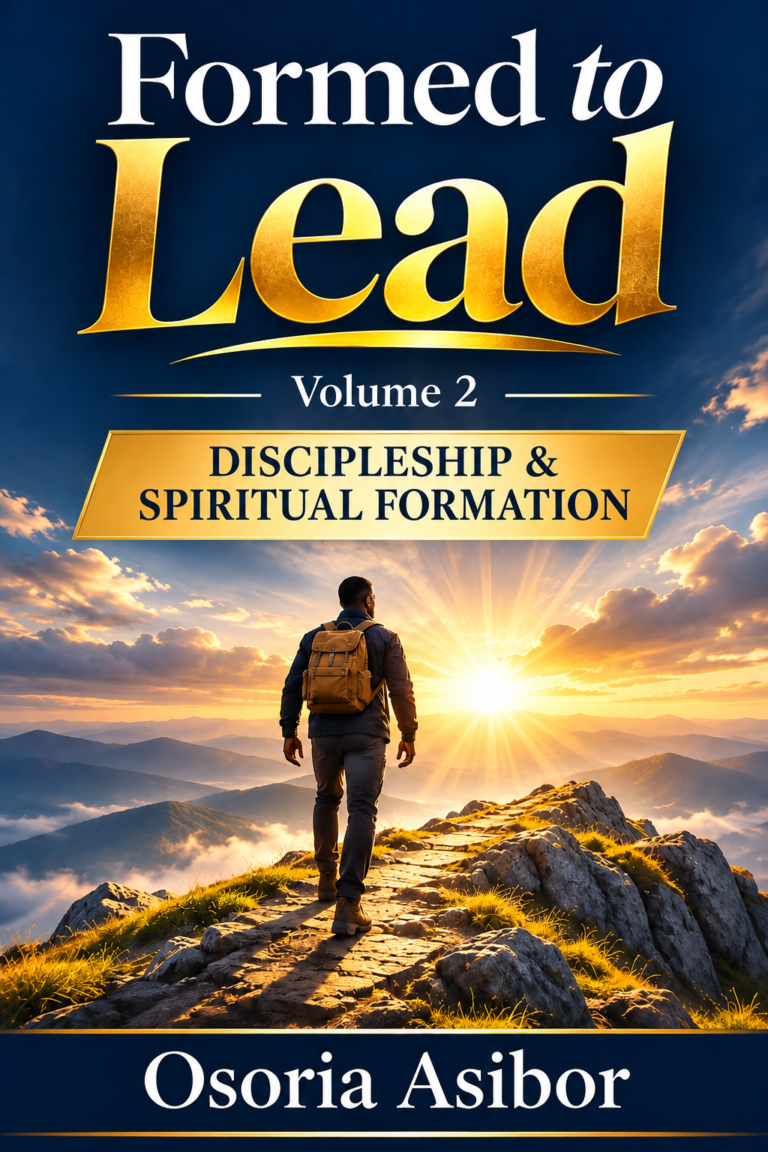
DISCIPLESHIP & SPIRITUAL FORMATION
Many believers understand identity and purpose, yet struggle to grow consistently. They desire depth but lack structure. They know what they believe, but not how to live it daily. This volume was written to address that gap. Volume Two focuses on discipleship and spiritual formation—the processes through which faith is strengthened, character is shaped, and spiritual maturity is built over time. It emphasizes that growth in Christ is not accidental; it is intentional, relational, and disciplined. This book explores: What it truly means to follow Christ beyond church attendance The cost of discipleship and the call to obedience Prayer as relationship, responsibility, and spiritual growth Hearing and discerning the voice of God Mastery of God’s Word for daily living Developing strong spiritual convictions Character formation, emotional discipline, and spiritual stamina The role of mentorship, accountability, and sound teaching in growth Written as a mentorship and discipleship manual, this volume is designed to be taught, discussed, and practiced. It includes structured teaching sections, reflection questions, and group activities, making it ideal for: Church discipleship programs Mentorship classes and cohorts Youth and young adult groups One-on-one mentoring relationships Personal study with accountability Formed to Lead – Volume 2 reinforces a vital truth: Spiritual growth requires discipline, guidance, and time. This is Volume Two in the Formed to Lead series. It builds on the foundations of identity and purpose established in Volume One and prepares readers for deeper growth, leadership development, and long-term faithfulness. Formation continues here. Remain rooted. Grow strong. Then lead with depth.
The full text is free to read here. Downloadable files are sold separately when available.
Read at your own pace
Formed to Lead
A Mentorship Blueprint for Christian Youth and Emerging Leaders
Volume 2: Discipleship & Spiritual Formation
Osoria Asibor
© 2026 Osoria Asibor
All rights reserved.
No part of this book may be reproduced, stored in a retrieval system, or transmitted in any form or by any means—electronic, mechanical, photocopying, recording, or otherwise—without prior written permission from the author, except for brief quotations used in reviews or scholarly works.
This book is published as Volume Two in the Formed to Lead mentorship series.
Title: Formed to Lead: A Mentorship Blueprint for Christian Youth and Emerging Leaders
Volume 2: Discipleship & Spiritual Formation
Author: Osoria Asibor
Scripture quotations in this book are taken from the King James Version (KJV) of the Holy Bible.
This book is intended for mentorship, discipleship, and educational purposes within Christian settings. While the principles shared are grounded in Scripture and experience, readers are encouraged to seek personal counsel and spiritual guidance when applying them to specific life situations.
All names, examples, and scenarios used for teaching illustrations are either fictional or used for instructional purposes only. Any resemblance to actual persons or situations is coincidental.
Printed in Canada
ISBN: 978-1-998308-22-4
DEDICATION
This book is dedicated to Pastor Tolu Otegbade.
Your genuine love for young people, your burden to see them formed rightly, and your consistent encouragement planted the seed for this series. You not only believed in the idea—you inspired it, nurtured it, and gave it direction.
Through your passion for mentorship and discipleship, you have shown that leadership begins with formation and that the future of the Church is secured when the next generation is intentionally guided.
This work exists because you chose to invest in people rather than platforms, in lives rather than applause.
Thank you for believing in this vision and for modeling what it means to lead by love, sacrifice, and purpose.
Table of Contents
Dedication
Author’s Charge
How to Use This Manual
From Foundation to Formation
MODULE 2: DISCIPLESHIP & SPIRITUAL FORMATION
2.1 Foundations of True Discipleship………………………15
• What It Truly Means to Follow Christ
• The Call to Follow Before the Call to Lead
• The Cost of Discipleship
• Discipline Versus Convenience
• Discipleship Requires Relationship
2.2 Prayer & Spiritual Growth………………………………..23
• Understanding Prayer as Relationship
• Building a Consistent Prayer Life
• Intercession, Fasting, and Spiritual Warfare
• Hearing and Knowing the Voice of God
• Growing Through Prayer Accountability
2.3 Word Mastery……………………………………………31
• The Centrality of God’s Word in Formation
• How to Study the Bible Deeply and Consistently
• Applying Scripture to Daily Living
• Developing Strong Spiritual Convictions
• Submitting to Sound Doctrine and Teaching
2.4 Character Formation………………………….….41
• Character as the Foundation of Spiritual Growth
• Integrity, Humility, and Obedience
• Managing Destructive Emotions
• Building Spiritual Stamina
• Character Is Formed in Process (Mentorship Emphasis)
Reflection Questions & Group Activities……………50
THE AUTHOR’S CHARGE
This book is not a standalone work. It is Volume Two of a structured mentorship and discipleship series designed to form Christian youth and emerging leaders deliberately, patiently, and thoroughly.
This volume is written with the understanding that identity must now be tested through obedience, and purpose must be strengthened through discipline. While foundations answer who you are, formation answers how you live. Growth does not end with clarity—it deepens through consistency.
Why This Volume Exists
This volume exists because identity without discipleship produces instability.
Many believers know who they are in Christ but struggle to walk consistently with God. They desire spiritual depth but lack discipline. They long for growth but resist process. This volume addresses that gap.
You cannot follow Christ without discipline.
You cannot grow spiritually without consistency.
You cannot sustain calling without character.
This volume exists to form habits, convictions, and spiritual stamina that support long-term faithfulness.
A Response to a Growing Gap
Across churches today, there is a widening gap between profession and practice. Many believers confess Christ sincerely, yet struggle with prayer, Scripture, and character. They are saved, but undisciplined. Gifted, but inconsistent.
This is not a failure of belief.
It is a failure of formation.
This volume was created to restore structure, accountability, and rhythm to the Christian walk.
What This Book Is Designed to Do
This volume is written as a discipleship and mentorship manual, not a devotional or motivational book. It is meant to be read slowly, discussed honestly, and practiced intentionally.
It is designed to:
• Establish disciplined spiritual habits
• Strengthen prayer life and Scriptural engagement
• Form godly character and emotional maturity
• Build endurance, obedience, and consistency
• Anchor growth within accountability and guidance
This volume does not promise quick transformation. It establishes patterns that produce lasting change.
How This Volume Fits into the Series
Each volume in this series addresses a distinct stage of formation. While Volume One focuses on foundations, this volume focuses on formation through discipline. Subsequent volumes will build on this work, addressing leadership, life skills, relationships, ministry calling, and kingdom influence.
Skipping discipleship weakens leadership.
Skipping formation destabilizes influence.
This volume must be practiced, not merely completed.
A Charge to Mentors and Teachers
If you are using this book to teach, mentor, or disciple others, understand this:
You are not merely teaching disciplines.
You are modeling a way of life.
Do not rush habits.
Do not shame inconsistency.
Do not reward performance over obedience.
Your consistency, correction, and patience will shape more than your words ever could.
A Charge to Mentees and Readers
If you are reading this volume as a learner, approach it with seriousness and humility. Spiritual formation requires effort, submission, and perseverance.
This volume may confront your inconsistencies.
It may expose neglected disciplines.
It may require uncomfortable adjustments.
Do not resist the process.
Do not compare your pace with others.
Allow God to shape your walk before He expands your influence.
A Final Word
This volume is not about spiritual appearance.
It is about spiritual endurance.
Prayer must be sustained.
The Word must be lived.
Character must be formed.
May this volume not only strengthen your devotion but stabilize your walk with God.
May it prepare you for the responsibility that growth always brings.
HOW TO USE THIS MANUAL
Understanding the Nature of This Book
This book is Volume Two in a multi-volume mentorship series. It is not designed to be rushed, skimmed, or consumed casually. Each volume in this series addresses a specific stage of formation, and this volume focuses on discipleship and spiritual formation—prayer, the Word, and character.
This manual is meant to be taught, discussed, and lived, not merely read.
The volumes in this series are intentionally progressive. What was established in Volume One is assumed here and developed further. For that reason, this manual should be completed carefully before moving to subsequent volumes.
Who This Manual Is For
This manual is designed for use by:
• Mentors, pastors, and teachers leading structured discipleship classes
• Youth and young adults committed to spiritual growth and maturity
• Churches and Christian organizations running long-term formation programs
It is suitable for:
• Group classes
• Small mentorship cohorts
• One-on-one mentoring
• Personal guided study (with accountability)
How This Volume Fits into the Series
This volume strengthens the foundation laid in Volume One. It addresses questions every believer must confront for sustained growth:
• How do I follow Christ consistently?
• How do I build a disciplined prayer life?
• How do I engage Scripture faithfully?
• How is character formed through obedience and endurance?
Later volumes will focus on leadership development, practical life skills, relationships, ministry calling, and kingdom impact. Without spiritual formation, leadership collapses under pressure.
Recommended Teaching Structure
This manual works best when taught slowly and intentionally.
Recommended pace:
• One main section per session
• One module over 6–10 weeks, depending on group maturity
• Group discussion and reflection after each session
Depth matters more than speed. Spiritual growth requires time.
Using This Manual in a Group Class Setting
For group mentorship classes:
• Begin each session with prayer
• Teach one major section at a time
• Use the brainstorming questions and case scenarios to drive discussion
• Allow mentees to reflect honestly before concluding
• Close with Scripture, prayer, and practical application
Mentors should guide conversation without controlling it.
Using This Manual for One-on-One Mentorship
For one-on-one mentoring:
• Assign sections for reading before meetings
• Discuss struggles, habits, and questions openly
• Help the mentee apply lessons to daily life
• Review spiritual disciplines regularly
• Emphasize accountability and consistency
The goal is transformation, not information.
Personal Study with Accountability
Individuals using this manual independently should:
• Study one section per week
• Reflect honestly on spiritual habits
• Write down convictions and action steps
• Share progress with a mentor or accountability partner
Growth without accountability is fragile.
Key Expectations for Mentors
Mentors using this manual are expected to:
• Model disciplined spiritual living
• Be patient with slow growth
• Encourage honesty, not performance
• Correct with love and wisdom
• Prioritize long-term formation over quick results
This manual supports mentorship—it does not replace it.
Key Expectations for Mentees
Mentees are expected to:
• Be teachable and consistent
• Participate actively in discussions
• Apply lessons practically
• Receive correction without defensiveness
• Commit to spiritual disciplines
Formation requires effort.
Progressing to the Next Volume
This volume should be completed and reviewed before moving to the next one in the series. Mentors are encouraged to:
• Assess spiritual habits, not just completion
• Revisit weak disciplines where necessary
• Ensure consistency in prayer, Scripture, and character
Only then should the group proceed to the next stage of formation.
A Final Instruction
Do not rush this manual.
Do not reduce it to routine.
Do not treat it as religious activity.
This volume is meant to establish disciplines that will sustain you through pressure, responsibility, and influence. When used prayerfully, patiently, and consistently, this manual will prepare readers not just for the next volume—but for a lifetime of faithful discipleship.
FROM FOUNDATIONS TO FORMATION
Volume One helped you answer essential questions of identity, purpose, vision, and destiny. It laid the groundwork that every believer needs before moving forward. But foundations alone are not enough. What has been established must now be formed into daily practice.
This volume marks a shift—from understanding to obedience, from clarity to consistency, and from intention to discipline. Knowing who you are in Christ is vital, but walking with Him requires structure, habits, and endurance. Spiritual maturity is not accidental; it is formed through repeated choices made in ordinary moments.
This stage of formation is not meant to be walked alone, but within the guidance, correction, and support of intentional mentorship.
Discipleship is where identity is tested. Prayer must become consistent, not occasional. Scripture must shape decisions, not merely inspire them. Character must be formed through obedience, not emotion. This is the quiet work that prepares a believer to carry responsibility without collapsing under pressure.
This transition is important. It reminds you that growth in God’s Kingdom is progressive. Each stage builds on the previous one, and skipping formation weakens everything that follows. What you practice here will either strengthen or destabilize your future leadership.
As you enter this volume, adjust your expectations. This is not a season of speed, visibility, or comparison. It is a season of faithfulness, discipline, and accountability. The results may not be immediate, but they will be lasting.
Formation is where roots grow deep.
Move forward patiently.
Practice consistently.
Submit willingly.
Module Two begins here.
MODULE 2: DISCIPLESHIP & SPIRITUAL FORMATION
2.1 FOUNDATIONS OF TRUE DISCIPLESHIP
WHAT IT TRULY MEANS TO FOLLOW CHRIST
Understanding discipleship beyond church attendance
Following Christ is more than believing the right things or attending church regularly. Discipleship is a daily decision to submit your life to the leadership of Jesus. Many people admire Jesus, but not everyone follows Him. A disciple is not a spectator; a disciple is a learner, a follower, and an imitator.
Jesus did not call people to admire Him—He called them to follow Him. Following Christ means allowing His teachings, values, and commands to shape how you think, live, and choose. It is a relationship that requires obedience, not convenience.
The Bible makes this clear:
Matthew 16:24 (KJV)
“Then said Jesus unto his disciples, If any man will come after me, let him deny himself, and take up his cross, and follow me.”
Discipleship begins with self-denial. This does not mean losing your identity; it means surrendering control. A disciple learns to say, “Not my will, but Yours.” Church attendance may expose you to truth, but discipleship trains you to live by that truth.
Many believers confuse activity with discipleship. You can serve in church, sing in the choir, or hold a title and still not be discipled. Discipleship is not measured by how busy you are in church, but by how closely your life reflects Christ outside church.
Jesus described true discipleship this way:
Luke 9:23 (KJV)
“And he said to them all, If any man will come after me, let him deny himself, and take up his cross daily, and follow me.”
Notice the word daily. Discipleship is not occasional. It is not seasonal. It is a lifestyle of obedience that must be practiced consistently.
This is where mentorship becomes essential. Following Christ was never designed to be done in isolation. Jesus discipled His followers in relationship. In the same way, Christian growth is strengthened when believers walk with mentors who guide, correct, and model the life of Christ.
Discipleship answers the question:
Who am I becoming as I follow Jesus?
If following Christ has not changed how you think, how you speak, how you manage relationships, and how you make decisions, then discipleship has not yet begun in its true sense.
THE CALL TO FOLLOW BEFORE THE CALL TO LEAD
Why submission precedes influence
In the Kingdom of God, no one is called to lead before learning how to follow. Leadership that is not rooted in submission becomes dangerous—both to the leader and to those being led. God’s pattern is clear: following always comes before leading.
Jesus did not begin by giving His disciples authority. He began by calling them to follow. They walked with Him, learned from Him, and submitted to His instruction long before they were sent out to represent Him. Influence was given only after character and obedience were formed.
The Bible confirms this order:
Luke 16:10 (KJV)
“He that is faithful in that which is least is faithful also in much: and he that is unjust in the least is unjust also in much.”
Faithfulness in following prepares a person for responsibility in leading. Those who cannot submit to guidance will eventually misuse authority. Submission teaches humility, patience, and accountability—qualities every leader must possess.
Many people desire leadership because they want influence, recognition, or a voice. But God looks first for those who are willing to be taught, corrected, and guided. In God’s system, submission is not weakness; it is training.
This is why mentorship is critical at this stage. A mentor represents structure, authority, and accountability in a believer’s life. Learning to follow a godly mentor prepares a person to lead others wisely later. Anyone who rejects guidance is not ready for influence.
Jesus modeled this principle clearly. Before the disciples were commissioned, they were instructed to observe, learn, and obey.
Matthew 28:20 (KJV)
“Teaching them to observe all things whatsoever I have commanded you…”
Leadership in the Kingdom flows from obedience. Influence is not claimed; it is entrusted. Those who rush leadership without submission often lead themselves—and others—into error.
Discipleship teaches you how to follow God’s voice. Mentorship teaches you how to follow godly guidance. Both are necessary before leadership is expressed.
Ask yourself this question honestly:
Am I more eager to be seen, or more willing to be shaped?
Those who learn to follow well will one day lead with wisdom, humility, and strength.
THE COST OF DISCIPLESHIP
Self-denial, obedience, and sacrifice
Discipleship is free, but it is not cheap. Salvation is a gift, but following Christ comes with a cost. Many people want the benefits of Christianity without embracing the demands of discipleship. Jesus never hid the cost. He made it clear from the beginning.
Discipleship requires self-denial. This means choosing God’s will over personal comfort, preference, and pride. It is not about self-hatred; it is about surrender. A disciple learns to place God’s authority above personal desire.
Jesus said:
Luke 14:27 (KJV)
“And whosoever doth not bear his cross, and come after me, cannot be my disciple.”
The cross represents sacrifice. It speaks of dying to self so that Christ can live through you. Discipleship will often require saying no to things that feel good but lead away from God. It will require discipline in areas others may consider unnecessary.
Obedience is another cost of discipleship. Obedience means doing what God says even when it is difficult, inconvenient, or unpopular. Many believers obey when it is easy, but disciples obey because it is right.
Jesus emphasized this clearly:
John 14:15 (KJV)
“If ye love me, keep my commandments.”
Love for Christ is proven through obedience, not words. A disciple measures love by submission, not emotion. Obedience trains the heart to trust God even when understanding is limited.
Discipleship also involves sacrifice. Time, comfort, reputation, and sometimes relationships may be affected. Following Christ reshapes priorities. What once mattered most may need to take second place to God’s purposes.
Jesus warned against shallow commitment:
Luke 14:28 (KJV)
“For which of you, intending to build a tower, sitteth not down first, and counteth the cost, whether he have sufficient to finish it?”
Discipleship is a long journey. Those who do not count the cost often start well but do not endure. This is why mentorship is vital. A mentor helps a disciple understand that sacrifice is not punishment—it is preparation. Sacrifice produces strength, clarity, and maturity.
The cost of discipleship is real, but it is not wasted. What you surrender to God is never lost. It is exchanged for spiritual depth, stability, and eternal reward.
Discipleship asks a serious question:
Am I willing to follow Christ even when it costs me something?
Those who answer yes are shaped into believers who can be trusted with responsibility, influence, and leadership.
DISCIPLINE VERSUS CONVENIENCE
Choosing spiritual growth over comfort
Spiritual growth does not happen by convenience; it happens by discipline. Convenience follows feelings, moods, and circumstances. Discipline follows commitment and obedience. Many believers desire growth, but few are willing to structure their lives to support it.
Discipline is choosing what is right over what is easy. Convenience waits for motivation; discipline acts out of responsibility. A disciple learns early that growth often requires doing spiritual duties even when there is no emotional drive.
The Bible is clear about this principle:
1 Corinthians 9:27 (KJV)
“But I keep under my body, and bring it into subjection: lest that by any means, when I have preached to others, I myself should be a castaway.”
Paul understood that spiritual life must be governed, not indulged. Discipline trains the will to submit to God even when the flesh resists. Without discipline, spiritual life becomes inconsistent and shallow.
Convenience-based Christianity leads to irregular prayer, inconsistent Bible study, and weak character. When believers pray only when they feel like it, read Scripture only when inspired, and obey only when it is easy, growth stalls. Discipline builds strength where convenience produces weakness.
Jesus emphasized disciplined commitment when He said:
Luke 9:62 (KJV)
“And Jesus said unto him, No man, having put his hand to the plough, and looking back, is fit for the kingdom of God.”
This statement highlights focus and endurance. Discipline keeps a believer moving forward even when distractions arise. It teaches perseverance, resilience, and spiritual stability.
This is where mentorship plays a crucial role. Discipline is difficult to sustain alone. Mentors help establish routines, correct excuses, and encourage consistency. Accountability turns good intentions into lasting habits.
Choosing discipline over convenience is not about legalism; it is about alignment. Discipline creates space for God to work deeply in a person’s life. Over time, what once felt difficult becomes natural, and what once required effort becomes part of daily life.
The real question discipleship asks is this:
Am I willing to do what strengthens my walk with God, even when it is uncomfortable?
Those who choose discipline are gradually shaped into believers who are dependable, spiritually mature, and prepared for responsibility.
DISCIPLESHIP REQUIRES RELATIONSHIP
Why disciples are formed through guidance, not isolation
Christian discipleship was never designed to be a private or isolated journey. From the beginning, God’s method for growth has been relationship. Jesus did not disciple people from a distance; He walked with them, corrected them, and modeled truth in daily life. Growth happens best where there is guidance, accountability, and example.
Many believers attempt to grow spiritually alone. While personal devotion is important, isolation often leads to blind spots, imbalance, and stagnation. Scripture teaches that spiritual growth is strengthened when believers walk with others who can speak truth into their lives.
The Bible states clearly:
Proverbs 27:17 (KJV)
“Iron sharpeneth iron; so a man sharpeneth the countenance of his friend.”
Discipleship involves sharpening. This requires proximity, honesty, and mutual commitment. A mentor provides perspective, correction, and encouragement that a disciple cannot always give to himself. Guidance helps prevent errors that often occur when individuals rely only on personal interpretation and emotion.
Jesus demonstrated relational discipleship consistently. He explained parables privately to His disciples, corrected their attitudes, and allowed them to observe both His power and His humanity. Their transformation happened because they were present with Him.
Mark 3:14 (KJV)
“And he ordained twelve, that they should be with him, and that he might send them forth to preach.”
Notice the order: they were with Him before they were sent. Relationship preceded assignment. Presence came before influence.
Mentorship reflects this biblical pattern. A mentor walks with a disciple through questions, struggles, discipline, and growth. Mentorship does not remove personal responsibility; it strengthens it. It provides structure, accountability, and wisdom that support long-term faithfulness.
Disciples formed in relationship grow with balance. They learn humility, submission, and patience. They understand that correction is not rejection and that guidance is not control. Relationship protects disciples from pride and isolation.
The key question is simple:
Who is walking with me as I grow?
Discipleship that is isolated is fragile. Discipleship that is relational is resilient. Those who submit to guidance are better prepared to guide others in the future.
2.2 PRAYER & SPIRITUAL GROWTH
UNDERSTANDING PRAYER AS RELATIONSHIP
Moving from ritual to communion
Prayer is not a religious routine; it is a relationship with God. Many believers pray regularly yet struggle to grow spiritually because their prayers have become mechanical. They recite words, repeat patterns, and follow schedules, but their hearts remain distant. True spiritual growth begins when prayer moves from ritual to communion.
Jesus did not treat prayer as an obligation. He treated it as fellowship with the Father. Prayer was not something He squeezed into His schedule; it was the source of His strength, direction, and obedience. If prayer is reduced to a task, it loses its power to shape the inner life.
The Bible describes prayer as relational access:
Hebrews 4:16 (KJV)
“Let us therefore come boldly unto the throne of grace, that we may obtain mercy, and find grace to help in time of need.”
Prayer invites us into God’s presence, not just into a moment of speaking. Communion means interaction—listening, responding, trusting, and aligning the heart with God’s will. When prayer becomes relational, it stops being driven by fear or duty and becomes motivated by love and dependence.
Ritual prayer focuses on performance: how long, how often, and how well. Relational prayer focuses on connection. It values honesty over eloquence and sincerity over structure. God is not impressed by rehearsed words; He desires an engaged heart.
Jesus emphasized this when He said:
Matthew 6:7 (KJV)
“But when ye pray, use not vain repetitions, as the heathen do: for they think that they shall be heard for their much speaking.”
Prayer as relationship allows space for silence, reflection, and listening. Growth happens when believers learn not only to speak to God, but also to hear from Him. Communion deepens trust, sensitivity, and obedience.
This is where mentorship becomes important. Many believers struggle in prayer not because they are unwilling, but because they were never guided. Mentors help disciples understand that prayer is learned through practice, correction, and example. Just as the disciples asked Jesus to teach them to pray, believers today grow when prayer is modeled and guided.
Prayer fuels spiritual growth because it keeps the believer connected to God’s presence. A prayerless life becomes self-directed. A relational prayer life remains God-dependent.
The key question this topic raises is simple:
Do I pray to complete a duty, or do I pray to commune with God?
When prayer becomes relationship, spiritual growth becomes steady, deep, and enduring.
BUILDING A CONSISTENT PRAYER LIFE
Developing sustainable prayer habits
Spiritual growth is sustained by consistency, not intensity. Many believers pray passionately for a short season and then gradually fade. Others wait for emotional motivation before they pray. A consistent prayer life is built not on feelings, but on discipline and structure.
Consistency means showing up regularly, even when prayer feels dry or routine. Growth happens when prayer becomes part of daily life, not an emergency response. Just as relationships grow through regular communication, intimacy with God grows through consistent engagement.
The Bible emphasizes persistence in prayer:
Luke 18:1 (KJV)
“And he spake a parable unto them to this end, that men ought always to pray, and not to faint.”
Jesus understood that prayer must be sustained over time. A believer who prays only when motivated will struggle to grow. Consistency trains the heart to depend on God daily, not occasionally.
Building a sustainable prayer life requires intentional habits. This includes setting specific times to pray, creating a quiet space, and removing distractions. Prayer should be planned, not improvised. When prayer is left to chance, it is often crowded out by busyness.
Daniel demonstrated disciplined prayer:
Daniel 6:10 (KJV)
“Now when Daniel knew that the writing was signed, he went into his house; and his windows being open in his chamber toward Jerusalem, he kneeled upon his knees three times a day, and prayed, and gave thanks before his God, as he did aforetime.”
Daniel’s prayer life was not seasonal. It was established. Consistency gave him strength under pressure and courage in adversity. Sustainable prayer habits produce spiritual stability.
Mentorship plays a critical role in this area. Many believers struggle with consistency because they lack guidance and accountability. Mentors help disciples develop realistic prayer routines, adjust expectations, and remain faithful when motivation is low. Accountability turns intention into practice.
A consistent prayer life does not require long hours every day. It requires faithful commitment. Short, sincere, regular prayers are more powerful than long, irregular ones. Over time, consistency deepens awareness of God’s presence and sharpens spiritual sensitivity.
The question this section invites is honest and personal:
Is my prayer life built on habit, or on convenience?
Those who commit to consistent prayer develop endurance, discernment, and a steady walk with God that sustains them through every season.
INTERCESSION, FASTING, AND SPIRITUAL WARFARE
Engaging spiritual responsibility with wisdom
Spiritual growth moves believers beyond personal needs into spiritual responsibility. Prayer is not only about asking God for help; it also includes standing in the gap for others, resisting spiritual opposition, and aligning with God’s purposes. Intercession, fasting, and spiritual warfare are expressions of mature prayer, not advanced rituals for a few believers.
Intercession is prayer on behalf of others. It reflects God’s heart for people and situations beyond oneself. A growing believer learns to carry burdens in prayer—not through worry, but through faith and responsibility.
The Bible says:
Ezekiel 22:30 (KJV)
“And I sought for a man among them, that should make up the hedge, and stand in the gap before me for the land, that I should not destroy it: but I found none.”
Intercession requires awareness, compassion, and persistence. It trains believers to think beyond self-interest and to partner with God’s redemptive work. Through intercession, spiritual maturity is deepened, and love for others is strengthened.
Fasting supports prayer by disciplining the body and sharpening spiritual focus. Fasting is not about punishing the flesh or manipulating God. It is about reducing distractions so the spirit can respond more clearly to God. When practiced with humility, fasting strengthens sensitivity, self-control, and dependence on God.
Jesus acknowledged fasting as part of spiritual life:
Matthew 6:16 (KJV)
“Moreover when ye fast, be not, as the hypocrites, of a sad countenance: for they disfigure their faces, that they may appear unto men to fast. Verily I say unto you, They have their reward.”
Notice that Jesus said when you fast, not if. Fasting is a tool, not a lifestyle, and it must be guided by wisdom, purpose, and spiritual maturity.
Spiritual warfare recognizes that believers live in a world where spiritual forces influence human experiences. Warfare prayer is not aggressive shouting or emotional expression; it is standing in truth, authority, and obedience. Spiritual warfare must always be grounded in Scripture and guided by discernment.
The Bible explains this clearly:
Ephesians 6:12 (KJV)
“For we wrestle not against flesh and blood, but against principalities, against powers, against the rulers of the darkness of this world, against spiritual wickedness in high places.”
Spiritual warfare is not about fighting people; it is about resisting spiritual opposition through prayer, truth, and righteousness. Mature believers understand when to pray, when to fast, and when to stand firm in faith without fear.
Mentorship is essential in this area. Without guidance, believers may become extreme, fearful, or unbalanced. Mentors help disciples understand spiritual responsibility with wisdom—knowing when to engage, how to remain grounded, and how to avoid pride or burnout.
Intercession, fasting, and warfare are not signs of superiority; they are signs of responsibility. They must flow from love, obedience, and humility.
The key question this section raises is this:
Am I spiritually aware and responsible, or spiritually active but unguarded?
Growth in prayer includes learning how to engage spiritual realities wisely, biblically, and under guidance.
HEARING AND KNOWING THE VOICE OF GOD
Learning discernment and spiritual sensitivity
Hearing God’s voice is not a mysterious gift reserved for a few believers. It is a relational skill developed through obedience, Scripture, and spiritual sensitivity. God desires to guide His people, but discernment is required to recognize His voice clearly.
God primarily speaks through His Word. Any leading, impression, or inner conviction that contradicts Scripture is not from God. Spiritual sensitivity grows when believers are rooted in truth, not emotion.
The Bible affirms this:
John 10:27 (KJV)
“My sheep hear my voice, and I know them, and they follow me.”
Notice that hearing and following are connected. God’s voice is recognized not only by sound, but by obedience. Those who consistently obey God become more sensitive to His guidance over time.
God also speaks through inner conviction, peace, and alignment with His character. However, not every thought, feeling, or desire is from God. Discernment requires patience, humility, and testing.
Scripture instructs believers to test what they hear:
1 John 4:1 (KJV)
“Beloved, believe not every spirit, but try the spirits whether they are of God: because many false prophets are gone out into the world.”
Spiritual sensitivity develops gradually. It is strengthened through prayer, study of Scripture, and submission to godly counsel. Quick decisions made without confirmation often lead to confusion. God’s voice brings clarity, peace, and alignment with truth—not pressure, fear, or confusion.
Mentorship plays a vital role in discernment. Mentors help believers interpret spiritual impressions, test convictions, and avoid emotional or impulsive decisions. Learning to hear God’s voice in community protects believers from deception and isolation.
God’s voice does not compete with chaos. It leads with order and wisdom.
1 Corinthians 14:33 (KJV)
“For God is not the author of confusion, but of peace, as in all churches of the saints.”
As spiritual sensitivity grows, believers learn when to wait, when to act, and when to seek counsel. Discernment matures through experience, correction, and obedience.
The honest question this section asks is:
Am I listening to God’s voice, or to my own desires?
Those who learn to hear God clearly are better prepared to make wise decisions, avoid error, and walk confidently in God’s will.
GROWING THROUGH PRAYER ACCOUNTABILITY
Why prayer life thrives with structure and guidance
A healthy prayer life rarely grows in isolation. While personal devotion is essential, accountability provides structure, consistency, and correction. Many believers desire a stronger prayer life but struggle because their efforts are unsupported and unexamined.
Accountability does not replace personal responsibility; it strengthens it. When believers know their prayer life is guided, reviewed, and encouraged, consistency improves and growth becomes intentional rather than accidental.
The Bible affirms the strength of shared spiritual effort:
Ecclesiastes 4:9–10 (KJV)
“Two are better than one; because they have a good reward for their labour.
For if they fall, the one will lift up his fellow: but woe to him that is alone when he falleth; for he hath not another to help him up.”
Prayer accountability creates space for honesty. It allows believers to admit struggles, dryness, distraction, or inconsistency without fear of judgment. This openness prevents guilt-driven prayer and replaces it with growth-focused discipline.
Mentorship plays a critical role here. A mentor helps a disciple:
Set realistic prayer routines
Evaluate consistency, not performance
Identify distractions and weak patterns
Encourage perseverance during dry seasons
Without guidance, prayer often becomes emotional—strong one week, absent the next. Accountability transforms prayer into a sustainable habit, not a seasonal activity.
Jesus modeled shared spiritual discipline. He prayed alone, but He also invited His disciples into prayer rhythms and taught them how to pray. Spiritual habits are learned best through example, correction, and shared practice.
Accountability also protects believers from extremes. Some become legalistic, measuring prayer only by hours and length. Others become casual, praying only when convenient. Mentorship brings balance—encouraging faithfulness without pressure.
The key question this section raises is practical:
Who knows the state of my prayer life, and who helps me grow in it?
A prayer life supported by structure and guidance grows deeper, steadier, and more resilient. Those who learn prayer within accountability are better equipped to sustain spiritual health over the long term.
2.3 WORD MASTERY
THE CENTRALITY OF GOD’S WORD IN FORMATION
Why Scripture shapes identity and direction
The Word of God is the foundation of spiritual formation. Prayer builds relationship, but Scripture provides truth, structure, and direction. Without the Word, spiritual growth becomes emotional, unstable, and easily misdirected. God’s Word anchors believers in what is true, not what feels right.
The Bible does not merely inform; it forms. It shapes how believers think, decide, and live. A believer may be passionate and sincere, but without deep engagement with Scripture, that passion lacks direction. The Word trains the mind and aligns the heart with God’s will.
Scripture explains its own role clearly:
2 Timothy 3:16–17 (KJV)
“All scripture is given by inspiration of God, and is profitable for doctrine, for reproof, for correction, for instruction in righteousness:
That the man of God may be perfect, throughly furnished unto all good works.”
Notice the process: doctrine, correction, instruction, and preparation. God’s Word builds maturity step by step. It does not only reveal what is right; it trains believers to live rightly.
The Word of God shapes identity by revealing who God is and who believers are in Him. It shapes direction by providing wisdom for decisions, relationships, and purpose. When Scripture is neglected, identity becomes confused and direction becomes uncertain.
The psalmist understood this:
Psalm 119:105 (KJV)
“Thy word is a lamp unto my feet, and a light unto my path.”
Formation requires light. God’s Word illuminates both the next step and the overall path. Without consistent engagement with Scripture, believers rely on opinions, emotions, and cultural influence.
Mentorship plays a vital role in Word mastery. Many believers own Bibles but were never taught how to study, interpret, and apply Scripture correctly. Mentors help disciples move from casual reading to intentional study. They teach how to observe, understand context, and apply truth responsibly.
The Word must not be treated as optional or secondary. It is the standard by which prayer, impressions, and experiences are judged. Spiritual maturity grows when believers learn to submit their thoughts, desires, and decisions to Scripture.
The question this section invites is foundational:
Is God’s Word shaping my life, or is it only informing my beliefs?
Those who master the Word develop stability, discernment, and clarity. Scripture does not merely prepare believers for ministry; it prepares them for life.
HOW TO STUDY THE BIBLE DEEPLY AND CONSISTENTLY
Practical approaches to Bible study
Many believers read the Bible regularly but struggle to understand it deeply or apply it consistently. Deep Bible study is not about speed or volume; it is about intentional engagement. Consistency builds familiarity, but depth produces transformation.
Studying the Bible deeply begins with approach. Scripture is not a casual book; it is God’s revealed truth. When the Bible is treated lightly, understanding remains shallow. When it is approached with reverence, patience, and humility, insight grows.
The Bible itself gives guidance on how it should be handled:
2 Timothy 2:15 (KJV)
“Study to shew thyself approved unto God, a workman that needeth not to be ashamed, rightly dividing the word of truth.”
Deep study requires effort. It involves learning to observe what the text says, understand what it means, and apply what it requires. Skipping any of these steps leads to confusion or misuse of Scripture.
Consistent study is built through routine, not inspiration. Waiting to feel motivated often results in irregular engagement. Setting a regular time, location, and study plan helps Scripture become part of daily life rather than an occasional activity.
A practical approach to Bible study includes:
Reading passages in context, not isolated verses
Asking basic questions: Who is speaking? To whom? Why?
Comparing Scripture with Scripture
Writing down insights and questions
The psalmist modeled this posture:
Psalm 1:2 (KJV)
“But his delight is in the law of the LORD; and in his law doth he meditate day and night.”
Meditation is not repetition; it is reflection. It means slowing down, thinking deeply, and allowing Scripture to shape understanding over time. Depth is developed when believers linger in the Word rather than rushing through it.
Mentorship is especially important in Bible study. Many believers become discouraged because they do not know where to start or how to interpret difficult passages. Mentors help disciples learn sound study habits, avoid misinterpretation, and grow in confidence with Scripture.
Consistency grows when expectations are realistic. Studying a small portion faithfully is more effective than attempting large portions irregularly. Depth grows gradually, and understanding increases with time.
The key question this section raises is practical:
Is my Bible study structured enough to grow me, or random enough to frustrate me?
Those who learn to study Scripture deeply and consistently develop clarity, conviction, and spiritual maturity that remains steady across seasons.
APPLYING SCRIPTURE TO DAILY LIVING
Turning revelation into obedience
The purpose of studying Scripture is not knowledge alone, but obedience. God’s Word was not given merely to be understood; it was given to be lived. When Scripture remains only at the level of revelation, growth is incomplete. Transformation happens when truth is applied to daily decisions, attitudes, and behavior.
Many believers enjoy learning Scripture but struggle with applying it. They know what the Bible says, yet their choices remain unchanged. This gap between revelation and obedience weakens spiritual formation. God’s Word produces fruit only when it is practiced.
Scripture makes this principle clear:
James 1:22 (KJV)
“But be ye doers of the word, and not hearers only, deceiving your own selves.”
Hearing without doing leads to self-deception. A believer may feel spiritually mature because of knowledge, yet remain unchanged in conduct. Obedience is the evidence that Scripture is shaping the heart.
Applying Scripture begins with intentional reflection. After reading a passage, a disciple should ask:
What does this require of me?
What attitude must change?
What action must follow?
Application often involves small, daily adjustments rather than dramatic changes. It may affect how one speaks, forgives, handles conflict, manages time, or makes decisions. Obedience is usually practical and sometimes uncomfortable.
Jesus emphasized obedience as the proof of true discipleship:
John 14:23 (KJV)
“Jesus answered and said unto him, If a man love me, he will keep my words: and my Father will love him, and we will come unto him, and make our abode with him.”
Love for God is demonstrated through obedience, not intention. Applying Scripture trains the will to submit to God’s authority even when emotions resist.
Mentorship plays a crucial role in application. Many believers understand Scripture but struggle to translate it into real-life situations. Mentors help disciples ask the right questions, identify blind spots, and apply biblical principles wisely. Accountability ensures that Scripture moves from theory into practice.
Application also requires patience. Growth is progressive. Obedience today prepares the heart for greater responsibility tomorrow. God often reveals truth gradually, allowing character to develop alongside understanding.
The key question this section raises is simple but honest:
What am I doing differently because of what I read in God’s Word?
Scripture that is applied produces humility, maturity, and spiritual stability. Those who obey God’s Word daily become believers whose lives reflect the truth they profess.
DEVELOPING STRONG SPIRITUAL CONVICTIONS
Standing firm in truth amid pressure
Spiritual convictions are settled beliefs rooted in God’s Word that guide decisions, actions, and responses under pressure. Convictions are not opinions, preferences, or emotions. They are truths so deeply anchored that they govern behavior even when obedience is costly.
Many believers know Scripture but lack convictions. When pressure comes—from peers, culture, fear, or convenience—they compromise easily. Convictions are what remain when feelings change and support disappears.
The Bible highlights the strength of conviction clearly:
Daniel 1:8 (KJV)
“But Daniel purposed in his heart that he would not defile himself with the portion of the king’s meat, nor with the wine which he drank: therefore he requested of the prince of the eunuchs that he might not defile himself.”
Daniel’s conviction was settled before the test arrived. He did not decide under pressure; he decided in advance. Strong convictions are formed before temptation, opposition, or opportunity presents itself.
Convictions are developed through consistent exposure to Scripture, obedience in small matters, and intentional discipleship. Truth becomes conviction when it is practiced repeatedly. What a believer obeys consistently becomes what they stand on confidently.
Pressure reveals the strength of convictions. When truth is not internalized, believers adjust their beliefs to fit circumstances. When convictions are strong, circumstances are confronted with truth.
Jesus emphasized this principle:
Matthew 7:24–25 (KJV)
“Therefore whosoever heareth these sayings of mine, and doeth them, I will liken him unto a wise man, which built his house upon a rock:
And the rain descended, and the floods came, and the winds blew, and beat upon that house; and it fell not: for it was founded upon a rock.”
Convictions are the foundation that prevents collapse during storms. Without them, believers may appear stable until pressure comes.
Mentorship plays a critical role in forming convictions. Mentors help disciples:
Distinguish truth from opinion
Identify areas where compromise is subtle
Strengthen resolve through accountability
Learn how to stand without becoming arrogant
Convictions must be held with humility and love. Strong convictions do not produce pride; they produce stability. They allow believers to stand firm while remaining teachable and gracious.
The honest question this section asks is this:
What truths am I willing to stand by even when it costs me approval, comfort, or advantage?
Those who develop strong spiritual convictions become believers who are not easily shaken, manipulated, or distracted. They are prepared for responsibility, leadership, and long-term faithfulness.
SUBMITTING TO SOUND DOCTRINE AND TEACHING
Why interpretation requires guidance and accountability
Sound doctrine is essential for healthy spiritual formation. Scripture is truth, but interpretation matters. When the Bible is read without guidance, accountability, or context, it can be misunderstood, misapplied, or even used to justify error. This is why submission to sound teaching is a vital part of Word mastery.
God never intended Scripture to be interpreted in isolation. While personal study is important, growth is strengthened when believers learn under tested, accountable, and biblically grounded teaching. Sound doctrine protects believers from deception, imbalance, and spiritual confusion.
The Bible warns clearly:
2 Peter 1:20 (KJV)
“Knowing this first, that no prophecy of the scripture is of any private interpretation.”
This does not mean believers cannot study Scripture personally. It means interpretation must be aligned with the whole counsel of God and tested within godly community. Private interpretation without accountability often leads to pride and error.
Sound doctrine provides boundaries. It keeps spiritual experiences, impressions, and convictions anchored in truth. Without doctrinal grounding, believers may chase novelty, exaggerate revelation, or elevate personal experience above Scripture.
Paul emphasized this responsibility:
2 Timothy 4:3 (KJV)
“For the time will come when they will not endure sound doctrine; but after their own lusts shall they heap to themselves teachers, having itching ears.”
Sound teaching is not always comfortable, but it is necessary. It corrects, stabilizes, and matures believers. Growth that avoids correction is fragile.
Mentorship is critical in this area. Mentors help disciples:
Interpret Scripture responsibly
Distinguish truth from opinion
Recognize doctrinal error early
Submit to correction without offense
Submission to sound teaching does not weaken faith; it strengthens it. It teaches humility and protects believers from spiritual independence that leads to isolation.
Jesus Himself modeled submission to truth. Though He taught with authority, He consistently affirmed Scripture as the final standard. Every believer, regardless of calling or gifting, must remain teachable.
The honest question this section raises is this:
Am I submitted to sound teaching, or do I only accept truth that agrees with me?
Those who submit to sound doctrine grow with balance, depth, and stability. They are less easily swayed by trends, personalities, or pressure, and more firmly rooted in the truth that sustains long-term faithfulness.
2.4 CHARACTER FORMATION
CHARACTER AS THE FOUNDATION OF SPIRITUAL GROWTH
Why gifting without character is dangerous
Character is the inner substance of a person. It is who you are when no one is watching. Spiritual growth that is not anchored in character is unstable, no matter how gifted or active a person may be. God is far more concerned with who you are becoming than with what you can do.
Gifting attracts attention, but character sustains trust. Many believers are gifted in speaking, leadership, prayer, or service, yet struggle spiritually because their character was never formed. When character is weak, gifting becomes dangerous—both to the individual and to those influenced by them.
The Bible warns clearly about this imbalance:
1 Corinthians 13:1–2 (KJV)
“Though I speak with the tongues of men and of angels, and have not charity, I am become as sounding brass, or a tinkling cymbal.
And though I have the gift of prophecy, and understand all mysteries, and all knowledge; and though I have all faith, so that I could remove mountains, and have not charity, I am nothing.”
Spiritual gifts without character produce noise, not fruit. God measures growth by love, obedience, humility, and faithfulness—not visibility or ability.
Character is formed through consistent obedience, correction, and submission. It develops slowly, often through pressure, waiting, and unseen faithfulness. Unlike gifting, character cannot be rushed or borrowed. It must be cultivated.
Jesus emphasized this foundation:
Luke 6:48–49 (KJV)
“He is like a man which built an house, and digged deep, and laid the foundation on a rock…
But he that heareth, and doeth not, is like a man that without a foundation built an house upon the earth…”
Character is the foundation that determines whether a life stands or collapses under pressure. When trials come, gifting may impress people, but only character sustains obedience.
Mentorship is essential in character formation. Character grows best under guidance, accountability, and correction. Mentors help disciples recognize blind spots, confront weaknesses, and develop integrity in private and public life. Without mentorship, character issues often remain hidden until failure exposes them.
God often delays promotion to protect character. He allows time for humility, patience, and obedience to be formed before responsibility increases. Those who resist this process often struggle when influence comes.
The honest question this section asks is this:
Am I more focused on developing my gifts, or on forming my character?
Spiritual growth that is rooted in character produces believers who are trustworthy, resilient, and prepared for long-term responsibility. Gifting may open doors, but character determines how long those doors remain open.
INTEGRITY, HUMILITY, AND OBEDIENCE
Core virtues every disciple must develop
Integrity, humility, and obedience are the core virtues that shape godly character. These qualities determine how a believer lives, responds to authority, and handles responsibility. Without them, spiritual growth becomes shallow and inconsistent.
Integrity is living truthfully and consistently, both in public and in private. It means that what a believer professes aligns with how they live. Integrity is not perfection; it is honesty, accountability, and faithfulness to God’s standards even when no one is watching.
The Bible affirms the value of integrity:
Proverbs 11:3 (KJV)
“The integrity of the upright shall guide them: but the perverseness of transgressors shall destroy them.”
Integrity guides decisions. It protects believers from compromise and double standards. When integrity is lacking, spiritual authority weakens and trust is broken.
Humility is recognizing dependence on God and remaining teachable. It is not self-degradation, but accurate self-awareness. Humility allows a disciple to receive correction, learn from others, and submit to God’s process without resistance.
Scripture teaches this clearly:
James 4:6 (KJV)
“But he giveth more grace. Wherefore he saith, God resisteth the proud, but giveth grace unto the humble.”
Humility attracts grace. Pride blocks growth. Disciples who resist correction often stagnate, while those who remain humble continue to mature.
Obedience is the outward expression of integrity and humility. It is choosing to do what God commands regardless of convenience or personal preference. Obedience proves trust in God’s wisdom and authority.
Jesus emphasized obedience as central to discipleship:
John 14:21 (KJV)
“He that hath my commandments, and keepeth them, he it is that loveth me…”
Obedience is not selective. True obedience responds to God fully, not partially. It trains the heart to submit even when understanding is incomplete.
Mentorship is critical in developing these virtues. Mentors help disciples see areas where integrity is tested, humility is challenged, and obedience is resisted. Through guidance and accountability, these virtues move from ideals to lived realities.
Integrity builds trust. Humility preserves growth. Obedience sustains alignment with God’s will. Together, they form a stable character that can handle responsibility and influence.
The honest question this section asks is this:
Do my daily choices reflect integrity, humility, and obedience, or only my intentions?
Disciples who develop these virtues become believers who are reliable, teachable, and spiritually grounded—ready for long-term faithfulness and service.
MANAGING DESTRUCTIVE EMOTIONS
Anger, lust, pride, envy, and self-control
Emotions are a natural part of human life, but when they are unmanaged, they become destructive. Spiritual growth requires learning how to recognize, govern, and submit emotions to God’s truth. Character formation is incomplete when emotions are allowed to rule decisions, reactions, and relationships.
Anger, lust, pride, and envy are not merely feelings; they are inner forces that can shape behavior if left unchecked. Many believers struggle not because they lack faith, but because their emotions are unmanaged and unexamined.
Scripture addresses this clearly:
Proverbs 4:23 (KJV)
“Keep thy heart with all diligence; for out of it are the issues of life.”
The heart is the control center. When emotions dominate the heart, they influence words, choices, and actions. Spiritual maturity involves learning to respond wisely rather than react impulsively.
Anger becomes destructive when it controls speech and behavior. While Scripture acknowledges righteous anger, it also warns against allowing anger to linger or lead to sin.
Ephesians 4:26–27 (KJV)
“Be ye angry, and sin not: let not the sun go down upon your wrath:
Neither give place to the devil.”
Unresolved anger opens doors to bitterness, division, and spiritual vulnerability.
Lust is desire without restraint. It seeks gratification without regard for consequences. When unchecked, lust distorts relationships, weakens self-control, and damages spiritual sensitivity.
James 1:14–15 (KJV)
“But every man is tempted, when he is drawn away of his own lust, and enticed.
Then when lust hath conceived, it bringeth forth sin…”
Pride elevates self above God and others. It resists correction and thrives on comparison. Pride is subtle and often hidden behind confidence or success.
Proverbs 16:18 (KJV)
“Pride goeth before destruction, and an haughty spirit before a fall.”
Envy resents the progress or blessing of others. It breeds comparison, insecurity, and dissatisfaction. Envy shifts focus away from God’s unique work in one’s own life.
James 3:16 (KJV)
“For where envying and strife is, there is confusion and every evil work.”
The solution to destructive emotions is not suppression, but self-control through the Spirit. Self-control allows believers to acknowledge emotions without being ruled by them.
Galatians 5:22–23 (KJV)
“But the fruit of the Spirit is love, joy, peace, longsuffering, gentleness, goodness, faith,
Meekness, temperance: against such there is no law.”
Mentorship is vital in emotional formation. Mentors help disciples identify emotional patterns, confront unhealthy responses, and develop godly habits. Emotions are best managed in accountability, not isolation.
Emotional maturity develops through prayer, Scripture, discipline, and correction. Over time, believers learn to pause, reflect, and respond with wisdom.
The honest question this section raises is this:
Do my emotions serve my spiritual growth, or do they control my behavior?
Disciples who learn to manage emotions grow in stability, discernment, and spiritual strength. They become believers whose lives are governed by truth, not impulse.
BUILDING SPIRITUAL STAMINA
Learning faithfulness over time
Spiritual stamina is the ability to remain faithful, obedient, and committed to God over time—especially when growth feels slow, pressure increases, or motivation fades. Many believers begin their journey with excitement but struggle to endure. Character formation is incomplete without stamina.
Stamina is not about intensity; it is about endurance. It is learning how to keep walking with God when prayers seem unanswered, when discipline feels difficult, and when results are not immediate. Spiritual maturity is proven by consistency, not bursts of enthusiasm.
The Bible emphasizes endurance clearly:
Hebrews 12:1 (KJV)
“Wherefore seeing we also are compassed about with so great a cloud of witnesses, let us lay aside every weight, and the sin which doth so easily beset us, and let us run with patience the race that is set before us.”
The Christian life is described as a race, not a sprint. Stamina requires patience, focus, and the willingness to keep moving forward despite obstacles. Those who lack stamina often grow discouraged and drift away when challenges arise.
Jesus warned about shallow commitment:
Matthew 13:20–21 (KJV)
“But he that received the seed into stony places, the same is he that heareth the word, and anon with joy receiveth it;
Yet hath he not root in himself, but dureth for a while: for when tribulation or persecution ariseth because of the word, by and by he is offended.”
Stamina is rootedness. When faith is shallow, pressure uproots it easily. When faith is deep, trials strengthen it.
Spiritual stamina is built through daily faithfulness. Simple habits—prayer, Scripture, obedience, accountability—practiced consistently over time produce strength. Skipping disciplines weakens endurance, while persistence strengthens it.
Mentorship plays a crucial role in building stamina. Mentors help disciples:
Remain steady during dry seasons
Interpret delays correctly
Avoid burnout and discouragement
Stay faithful when progress feels slow
Many believers quit too early, not because God is absent, but because they misunderstand process. God often uses time to refine character, deepen trust, and prepare believers for future responsibility.
The Bible encourages perseverance:
Galatians 6:9 (KJV)
“And let us not be weary in well doing: for in due season we shall reap, if we faint not.”
Stamina keeps a believer present until the season of harvest arrives. Those who endure develop depth, reliability, and long-term usefulness in God’s work.
The honest question this section asks is this:
Am I building a faith that lasts, or one that only works when things are easy?
Believers with spiritual stamina become dependable disciples—able to carry responsibility, serve faithfully, and remain steady through every season of life.
MODULE 2: DISCIPLESHIP & SPIRITUAL FORMATION
REFLECTION QUESTIONS & GROUP ACTIVITIES
2.1 FOUNDATIONS OF TRUE DISCIPLESHIP
Group Reflection Questions
When you hear the word disciple, what comes to your mind first?
In practical terms, how is following Christ different from attending church?
Why do you think many people desire leadership without learning submission?
What does “counting the cost” of discipleship look like in your daily life?
Who is currently influencing your spiritual growth, and how?
Group Activity: Follow or Observe
Activity:
Split into small groups. Ask each group to discuss this scenario:
Two believers attend the same church.
One is always present but avoids correction and accountability.
The other is teachable, submitted, and consistent, though less visible.
Discussion Prompts:
Which one reflects true discipleship? Why?
What long-term outcomes do you expect for each person?
2.2 PRAYER & SPIRITUAL GROWTH
Group Reflection Questions
How would you honestly describe your prayer life right now?
What makes prayer difficult to sustain consistently?
What is the difference between praying out of duty and praying in relationship?
Why do you think accountability improves spiritual disciplines?
Who knows the real state of your prayer life?
Group Activity: Prayer Audit
Activity:
Ask mentees to privately write down:
When they pray
How often they pray
What usually interrupts prayer
Then discuss as a group:
What patterns did you notice?
What small change could improve consistency this week?
2.3 WORD MASTERY
Group Reflection Questions
What role does Scripture currently play in your decision-making?
Why do some believers read the Bible often but live unchanged?
What challenges do you face when studying the Bible?
Why is interpretation risky without guidance?
What truth from Scripture recently challenged your behavior?
Group Activity: From Reading to Living
Activity:
Read a short Scripture together (mentor chooses).
Ask each group:
What does this Scripture say?
What does it require in real life?
What would obedience look like this week?
Emphasize that application, not explanation, is the goal.
2.4 CHARACTER FORMATION
Group Reflection Questions
Why do you think character matters more than gifting in the long run?
Which emotion do you struggle with most: anger, pride, envy, or self-control?
How does pressure reveal character?
Why is consistency harder than enthusiasm?
What does spiritual stamina look like in everyday life?
Group Activity: Pressure Test
Activity:
Present this scenario:
A believer is gifted and growing, but faces repeated delays, correction, and lack of recognition.
Discussion Prompts:
What character traits are being tested?
What emotions might surface?
How should a mature disciple respond?
CLOSING GROUP EXERCISE FOR MODULE 2
Personal Commitment Exercise
Ask mentees to complete this sentence privately, then share voluntarily:
“One spiritual habit I need to take more seriously is __________.”
Mentors should:
Encourage honesty
Avoid judgment
Help mentees choose one realistic action step for the coming week
MENTOR GUIDANCE NOTE
Do not rush discussions
Allow silence where needed
Listen more than you speak
Emphasize progress, not perfection
A PAUSE FOR FORMATION
Discipleship and spiritual formation are not phases to complete; they are foundations to maintain. What has been explored in this module is not meant to produce perfection, but direction—a steady movement toward maturity, obedience, and consistency.
Prayer, the Word, and character are not separate disciplines. They work together to shape the inner life. When prayer becomes relational, Scripture becomes formative, and character becomes intentional, spiritual growth becomes sustainable.
This module has emphasized an important truth: growth thrives under guidance. Discipline is strengthened through accountability. Convictions are formed through truth. Character is refined through correction and endurance. No believer grows well alone.
As you move forward, resist the temptation to rush into visibility or responsibility. God is more interested in depth than speed. Formation protects destiny, and consistency preserves calling.
Take time to review what you have learned. Apply what has been revealed. Strengthen habits that support growth. Where weaknesses have been exposed, allow correction to do its work.
Disciples are not formed in moments—they are formed over time.
With these foundations established, you are now prepared to move into the next stage of formation: personal growth and mindset development, where inner discipline meets practical responsibility.
You can continue reading free. If a downloadable edition is offered, the purchase button opens a secure product checkout—not a public PDF file.
Browse other books